


Exploring Every Day Life in the Caribbean with Loïc Girard

July Artist of the Month | Loïc Girard
Loïc Girard is a French-Caribbean visual artist and landscape architect based in Guadeloupe. Working primarily in black ink on paper, his drawings examine the places, people, and everyday situations that shape Caribbean life. Streets, markets, harbors, architecture, vegetation, and passing encounters become subjects through which he explores cultural heritage, identity, and the ways places influence community.
His artistic practice exists alongside his work in landscape architecture and his doctoral research on vernacular Creole landscapes in Guadeloupe. Together, these disciplines have shaped the way he observes his surroundings and considers the relationship between people, culture, and the environments they inhabit. His drawings ask what everyday life can reveal about people and culture.
"I do not want people to see the Caribbean as an exotic postcard, or as a place defined only by tropical colours, beaches and spectacular landscapes. I want them to see people, relationships, ordinary places and the complexity of everyday life." - Loïc Girard

Learning to Look
Loïc Girard has always drawn, but he did not initially think of himself as an artist. His professional life began in landscape architecture, a field that brought him into close contact with the places he would eventually begin documenting through drawing. For approximately fifteen years, he has worked in Guadeloupe, observing its landscapes, buildings, vegetation, infrastructure, and the ways people inhabit them. Over time, drawing became another way of examining those environments.
What began as observation, gradually developed into a deeper inquiry. Girard became interested in what a landscape looked like, and in what it could reveal about the people who shaped it. A street, a building, a harbor, or a gathering place could contain traces of history, social relationships, cultural habits, and ongoing change. That interest has also become central to his doctoral research on Creole landscapes.
His research examines how these landscapes are formed through processes of Creolization, in which cultures, practices, people, and environments continually influence and reshape one another. For Girard, this is not just an academic concept, it is something he encounters in the places around him. His drawings offer another way to examine how these relationships take shape within the landscape.
"Black and white introduces distance. It can make an image feel timeless, but also slightly crepuscular." - Loïc Girard

Beyond a Traditional Postcard
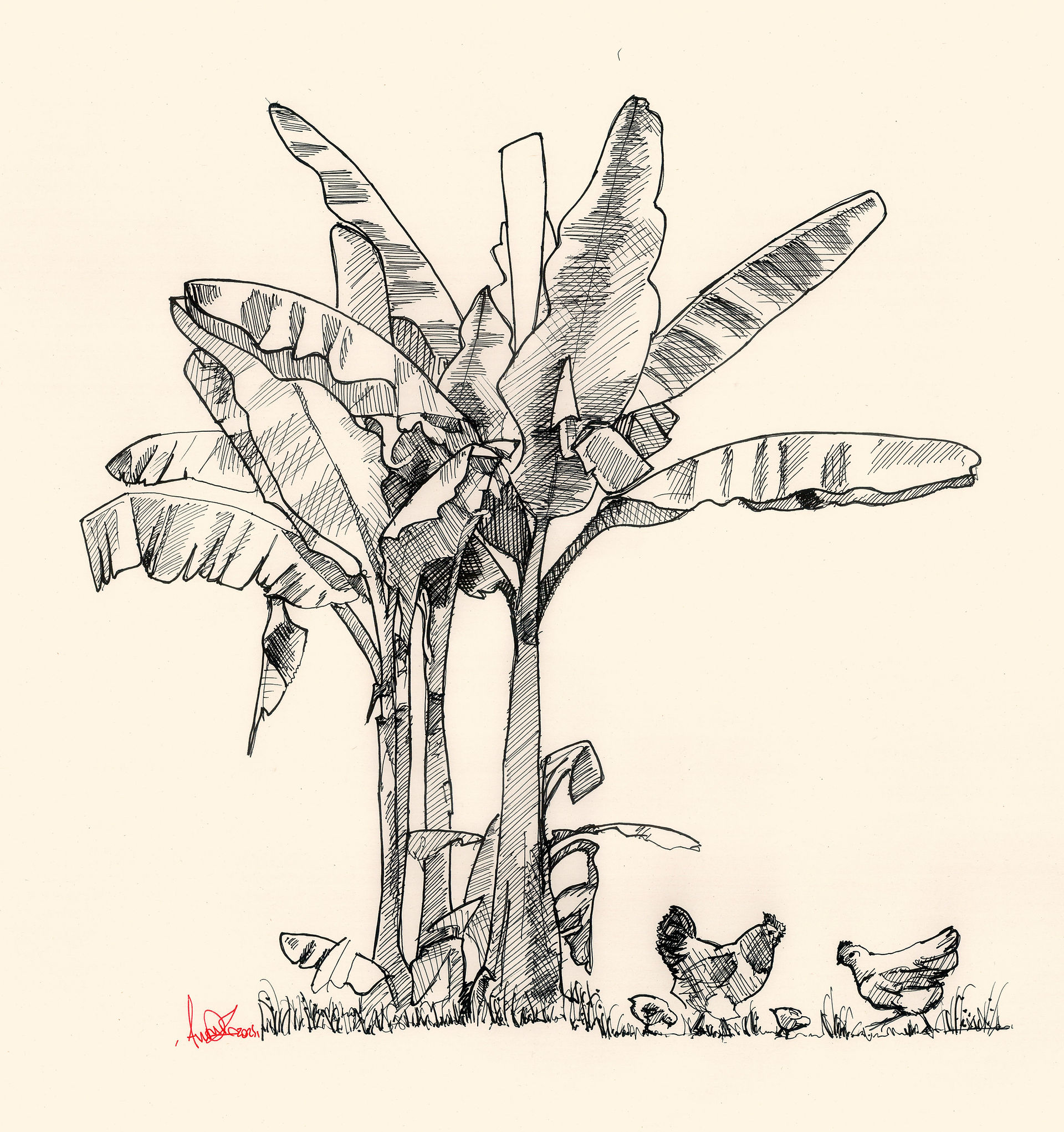
The Caribbean is often represented through a familiar visual vocabulary, with bright colors, tropical vegetation, beaches, water, and landscapes presented as idyllic destinations. Girard deliberately works against that expectation, his drawings are rendered almost entirely in black ink on paper, using a simple, inexpensive pen. His choice in medium is very intentional, instead of saturated colors commonly associated with Caribbean imagery, he reduces the visual field to line, shadow, texture, and form, the black and white creating a sense of distance.
"There is something meaningful to me about creating drawings that can endure with such a modest instrument." - Loïc Girard
Girard describes an interest in the atmosphere of dawn and dusk, transitional moments when things are becoming visible or beginning to disappear. That feeling of being between states mirrors his broader interest in landscapes and cultures, the Caribbean he depicts is lived in. It is a place where people work, wait, gather, talk, play, travel, build, adapt, and change their surroundings. A domino game, a street corner, a shop, or someone simply standing in a familiar place, they become as significant as a formally recognized landmark.
This attention to the ordinary is central to Girard's understanding of heritage. “Heritage” does not exist only in monuments, historic buildings, or traditions officially designated for preservation. It can also exist in gestures, habits, social spaces, relationships, and ways of existing. These everyday practices may seem unremarkable while they are happening, but they are also the things through which culture continues to be produced, his drawings bring those moments into focus.

Observation
Girard's process begins before the drawing itself. He photographs places and situations that catch his attention, makes mental notes, and sometimes allows an image to remain in his memory for months before returning to it. The final drawing is rarely a direct reproduction of a single photograph, instead, he selects from different observations, changing proportions, removing details, combining elements, and constructing a composition that communicates something about the place rather than simply recording it.
Girard is not interested in documentation for its own sake, he is interested in what can be revealed through looking carefully. Once he begins drawing, the process becomes deliberately slow. His larger works are constructed from thousands of individual lines, gradually building figures, buildings, large palms, or chickens pecking away at the earth. The simplicity of the tool contrasts with the simplicity and complexity of the finished image.
A scene that might take only a few seconds to pass becomes something he studies for hours. A person's posture, the relationship between a building and a tree, the movement of people through a public space, or a seemingly insignificant gesture can become visible in ways that ordinary observation rarely allows.
“Drawing has taught me to slow down,” Girard explains. “When you spend hours looking at a scene, you begin to notice things that would normally disappear.”

A Living Heritage
This way of working has led Girard toward a broader question: what do we choose to remember? His interest in cultural heritage is not just nostalgia. In fact, he is careful to distinguish his work from attempts to freeze the Caribbean in an idealized version of its past. The landscapes and communities he draws are constantly changing. Migration, climate, memory, and everyday cultural practices continually reshape them.
This ongoing transformation is part of what Girard means when he speaks about Creolization, not the historical mixing of cultures, but an active process of recomposition that continues in the present, that makes the ordinary especially important. A familiar street or neighborhood may not seem historically significant today, a particular way of gathering, working, or moving through a space may feel completely routine. Yet these are the experiences through which people create a sense of place and pass culture on to the next generation. Girard's drawings become more of a visual archive, a way of paying attention to it while it is happening.
“What appears ordinary is often what carries the most meaning,” - Loïc Girard


Community & Connection
Community is a subject within Girard's work, many of his drawings focus on where people naturally come together: markets, streets, gathering places, and other informal social environments. These spaces function as small social ecosystems, created by the people who occupy them and the interactions that take place there.
The people who gather there, the activities they share, and the habits they repeat help give it meaning. In this sense, Girard's interest in vernacular landscapes extends naturally into his interest in community. The built environment and the social life surrounding it are constantly influencing one another, shaping the way he hopes viewers encounter his work. He wants viewers to experience a Caribbean that is recognizable as a lived place rather than a destination.
"Sometimes a very ordinary situation becomes interesting simply because I have learned to look at it differently." - Loïc Girard
Looking Forward
Girard's practice continues to develop, and he is currently working on increasingly large-format ink drawings while deepening the relationship between his artistic practice and his doctoral research into Creole landscapes, identity, and Creolization. He also hopes to expand his work beyond Guadeloupe, traveling throughout the Caribbean to explore the connections between its different territories. Although the region is often divided into individual islands and destinations, Girard sees deeper relationships running through them, like shared histories, migrations, languages, cultural practices, and processes of cultural transformation.
Ultimately, he hopes his work can contribute to a broader understanding of the Caribbean. What do we overlook because we see it every day? What becomes heritage, and who decides? How do places carry the memory of the people who inhabit them? And how much of the culture we think of as inherited is actually being created around us, right now?
Learn More & Support Loïc Girard

Apply for the Artist of the Month Program

Submit Your Work for Where We Are Magazine

Get Involved & Join the Community!


Comments